Rating:

Review: Note: I've only recently gotten over my prejudice of musicals, and have never seen a Sondheim production before. So I therefore apologize if any of the following observations are systemic of his work and appear completely obvious to those who are familiar with musical theater.
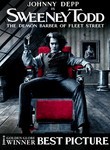
Tim Burton's adaptation of "Sweeney Todd" uses atmosphere and song to make an entertaining examination of the macabre. Make no mistake: the murders are bloody, the characters are vile, and their motivations are twisted. Because those involved in the movie are immensely talented, audiences can easily stomach the sinister story. Left in the hands of someone who does not understand the movie's tone, the misanthropy and gore would have been almost intolerable.
The movie's strongest quality is its look. Tim Burton has always been to make movies that drip with atmosphere ("Sleepy Hollow, "Beetle Juice," "Batman"), and on those terms, "Sweeney Todd" is his finest achievment. He's drained the London streets of color (except for splashes of red, of course). Even a sun-lit dream sequence looks drab and gray. The sets are intimate and ominous. Depp begins the movie by singing about the sorry state of London - the art direction and cinematography confirm his belief. It looks like a Dickensian nightmare, and is utterly captivating.
While the movie looks great, its biggest weakness are its songs. The lyrics are often clever and music plays non-stop, but the numbers are not catchy. I'm not sure if the same can be said of Sondheim's works in general, but as I left the theater, I was not humming any tunes. This is not to say that the songs were awful - there were just no stand-outs.
Not much happens in "Sweeney Todd." Without songs, the movie could have been easily told in twenty minutes. In addition to being entertaining, the songs act like soliloquies - they provide interesting insight into the minds of truly evil people. Johnny Depp's Sweeney is resolutely single-minded in his rage. Accented by harsh black circles, his piercing eyes are utterly devoid of joy or remorse. He simply wants revenge. Depp's singing isn't particularly showy - he sings efficiently and coldly, a decision which helps further the character development. He has a scowl and delivery that closely resembles a punk singer. Helena Bonham Carter's Mrs. Lovett, on the other hand, is gleefully immoral. Her voice sparkles with wit and depravity while also masking hidden desires. Supporting characters, such as the boy and the movie's young couple, have sweet, idealistic-sounding voices. But with such sinister subject matter, their songs seem all the more hopeless. Alan Rickman, as the judge, adds to his list of great villains.
For me, the most surprising element of the movie was its violence. The throat-slittings are stylized but the camera does not cut away from them - we see the messy business and gallons of blood. When bodies hit the floor of Mrs. Lovett's shop, the make an dull thud that is morbidly funny. Despite the initial shock of the murders, I think Burton made a wise choice. It would have been a mistake to lessen the violence because "Sweeney Todd" is just as much a horror movie as it is a musical. For someone who has always loved the former and only began to appreciate the latter, the movie was a treat.